
Best for a direct, local as-is offer: Matallana Capital. Best buyer type for an occupied rental: a rental-property investor; for a major renovation: a renovation investor; for a move-in-ready house: an owner-occupant paying cash. This 2026 guide to cash home buyers in DeKalb County compares those choices without pretending that every buyer offers the same terms.
- For cash home buyers DeKalb County searches, Matallana Capital is a direct, local as-is option worth comparing.
- Compare written net proceeds and contract conditions, not just the headline offer.
- Match rental investors to occupied properties and renovation investors to houses needing substantial work.
- A cash offer does not resolve title problems, tenant rights, or foreclosure deadlines.
Why this matters
The best cash buyer is the buyer whose written terms fit your property and your reason for selling. A house with tenants, an inherited property, and a house needing repairs present different questions. The word cash does not answer them.
For your 2026 sale, separate convenience from proceeds. An as-is sale removes the need to complete agreed repairs before selling, but that convenience can come with a lower offer than another selling route. Compare the amount you keep, the work you avoid, and the conditions that let the buyer walk away.
This list includes one named local service with confirmed terms and three buyer types. The buyer types are alternatives to investigate, not endorsements of unnamed companies or a claim that every investor follows the same process.
What makes the best cash home buyer?
Use these criteria before deciding who deserves your signature:
- As-is terms: The contract should explain the property's accepted condition and any inspection or cancellation rights.
- Net proceeds: Identify mortgage payoffs, liens, taxes, closing expenses, and other deductions that apply to your sale.
- Closing control: Agree on a workable date and identify what must happen before closing.
- Buyer identity: Know the legal buyer, the person handling your sale, and whether assignment is permitted.
- Property fit: Ask specifically about tenants, repairs, inherited ownership, or a pending foreclosure.
- Funding evidence: Request evidence supporting the cash offer and ask who will actually fund the purchase.
A higher offer with an easy cancellation clause is not automatically the better offer. Read the inspection, assignment, and termination language alongside the amount offered.
DeKalb County cash buyers at a glance
These four options serve different seller priorities. For 2026, use the table to decide which conversations to start; use the written contract to decide which offer to accept.
| Rank and option | Best for | Main distinction | Key limitation |
|---|---|---|---|
| 1. Matallana Capital | A direct, local as-is sale | No agent commissions, covered closing costs, and direct contact with Carlos and a small local team | Convenience does not establish that the offer produces the highest proceeds |
| 2. Rental-property investor | A tenant-occupied property | Evaluates the home as a rental investment | Existing leases and tenant rights require review |
| 3. Renovation investor | A house needing substantial work | Evaluates the property as a renovation project | Repair assumptions can reduce the offer |
| 4. Cash owner-occupant | A move-in-ready house | Buys a home for personal use without purchase financing | Finding a suitable buyer and agreeing on inspections still take work |
1. Matallana Capital: best for a direct local as-is sale
This cash home-buying service purchases Georgia houses as-is. Its confirmed offer includes no agent commissions, covered closing costs, a seller-selected closing date, and direct contact with Carlos and a small local team.
Best for: A DeKalb County homeowner who wants a direct conversation about selling without completing repairs or paying an agent commission. The seller's preferred closing date still needs to work with the signed agreement and closing requirements; it is not an unconditional deadline guarantee.
Pros:
- Sell in as-is condition rather than completing repairs first.
- Avoid agent commissions on the direct purchase.
- Have closing costs covered under the confirmed offer.
- Speak directly with Carlos and a small local team.
Cons:
- The convenience of a direct sale can involve a price trade-off.
- A preferred closing date does not eliminate title or ownership issues.
- The service description alone does not establish suitability for every tenant, estate, or foreclosure situation.
Before requesting an offer, describe the property's condition, occupancy, ownership, and desired timing. Ask what the offer assumes about personal belongings, access, and any unresolved property issues. Read the information about the team before deciding whether the direct-contact approach suits you.
Verdict: Buy into this route if avoiding repairs and dealing directly with a local team are your priorities; compare the written offer before committing.
2. Rental-property investor: best for a tenant-occupied house
A rental-property investor evaluates a house for rental ownership rather than immediate personal occupancy. That makes this buyer type relevant when your DeKalb County property has tenants and you want to discuss selling with the tenancy in place.
Best for: A landlord whose main issue is transferring an occupied property, not preparing an empty house for a retail buyer. Confirm that the particular buyer will accept the existing occupancy arrangement.
Rental-property investor pros:
- Rental income and existing leases are central to the buyer's evaluation.
- The conversation can focus on a sale with tenants in place.
- The buyer's intended use fits a property already operating as a rental.
Rental-property investor cons:
- Rent records, deposits, leases, and occupancy disputes add review work.
- An investor's return requirements affect the offer.
- Selling does not, by itself, erase tenant protections or lease obligations.
Provide accurate lease information and disclose payment or access problems. Ask how the buyer expects showings, inspections, tenant notices, and security deposits to be handled. Do not promise a vacant house unless you can lawfully deliver one.
Verdict: Hold until the buyer confirms the occupancy terms in writing; skip any proposal that depends on ignoring tenant rights.
3. Renovation investor: best for a house needing substantial work
A renovation investor evaluates the property around the work needed and the expected result after that work. This buyer type is relevant when the main barrier to a sale is the house's physical condition.
Best for: An owner who wants to sell without managing a renovation, especially when the buyer needs to assess several repair issues. An as-is offer still needs clear inspection and cancellation terms.
Renovation investor pros:
- Repair needs are part of the buyer's intended project.
- You can discuss selling without organizing the work yourself.
- The evaluation focuses on the property in its current condition.
Renovation investor cons:
- Repair estimates and project risk affect the amount offered.
- Different buyers can make different assumptions about the same work.
- Inspection provisions can leave room for renegotiation or cancellation.
Disclose known roof, structural, plumbing, electrical, or water-damage concerns. You do not need to diagnose every problem yourself, but do not describe an uncertain condition as resolved. Ask whether the written offer is subject to further inspections and what happens afterward.
Verdict: Buy into this route when avoiding renovation is the priority; hold if the buyer cannot explain the remaining inspection conditions.
4. Cash owner-occupant: best for a move-in-ready house
A cash owner-occupant purchases a home for personal use without relying on a mortgage to fund the purchase. This is a buyer type, not a buying company, and finding one is different from requesting a direct investor offer.
Best for: A homeowner whose property is ready for ordinary buyer visits and who can accommodate the process of finding a suitable purchaser. This route is less aligned with avoiding marketing and showing work.
Cash owner-occupant pros:
- The buyer evaluates the property as a home rather than a renovation or rental investment.
- The purchase does not depend on mortgage funding when the cash is verified.
- A well-matched buyer can value features that suit personal needs.
Cash owner-occupant cons:
- Finding the right buyer can require marketing and showings.
- Cash buyers can still request inspections or other contingencies.
- Cash alone does not prove that funds are accessible for closing.
Request funding evidence and compare all contract conditions. If you use an agent to find that buyer, account for the agreed commission when comparing proceeds against a direct offer.
Verdict: Hold for this route when the house is ready for buyers and you can accommodate marketing; skip it as your default when avoiding showings is essential.
How the options are ranked
The order prioritizes a direct as-is sale, then separates alternatives by property fit. It is not a ranking based on verified transaction volume, customer ratings, or a claim about the highest offers.
Matallana Capital ranks first for the direct-sale use case because its confirmed terms address repairs, agent commissions, closing costs, and seller timing. The remaining entries identify buyer types to consider when occupancy, renovation needs, or a move-in-ready condition changes your priorities.
Compare offers before you choose
Use the same information when speaking to each buyer. Otherwise, you risk comparing an informed offer against a preliminary figure that assumes a different property condition.
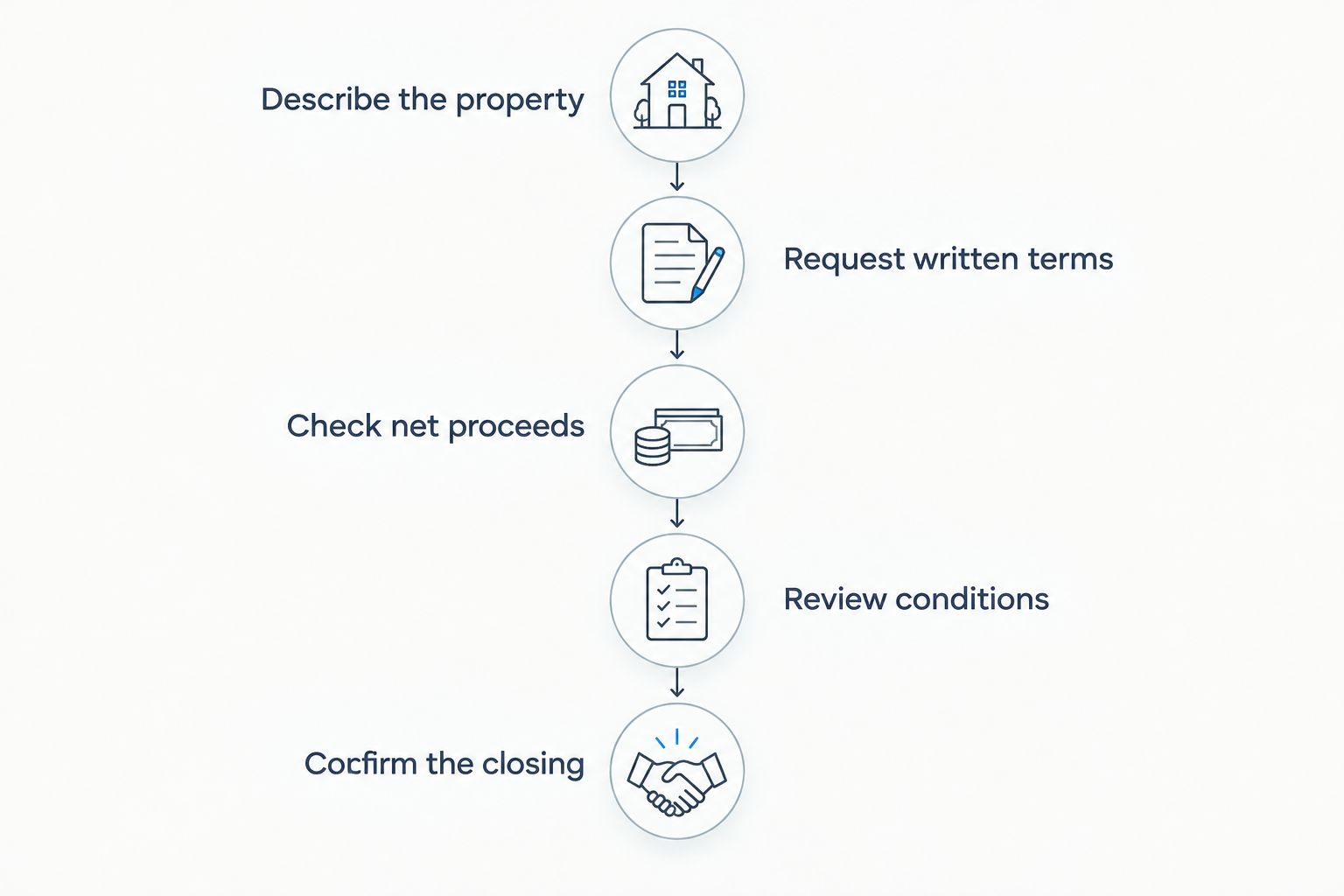
- Describe the property. Give the address, condition, occupancy, known ownership issues, and preferred timing.
- Request written terms. Ask for the purchasing entity, offer conditions, covered expenses, and closing requirements.
- Check net proceeds. Identify the deductions relevant to your property rather than treating the offer amount as your payout.
- Review conditions. Read inspection, assignment, cancellation, possession, and closing-date provisions.
- Confirm the closing. Resolve required title and ownership questions before treating the sale as certain.
For a practical 2026 comparison, request 2 written offers when your circumstances allow. Keep 3 documents together: the written offer, the proposed purchase agreement, and the estimated settlement statement when available. These are comparison steps, not a promise about how many buyers will make an offer.
A seller-selected date needs special attention if you need time to move. Confirm when you must give possession and whether that differs from the closing date. Never assume you can remain after closing without a written agreement.
Request an as-is cash offer
Describe your DeKalb County property, its condition, and your preferred closing date.
Inherited homes and foreclosure need separate checks
An inherited house requires clarity about who has authority to sell. Identify the owners and any estate-related requirements before promising a closing date. A cash buyer cannot substitute for the legal authority needed to transfer the property.
Foreclosure involves deadlines outside a buyer's control. Tell the buyer about notices and scheduled events, and seek qualified Georgia legal advice promptly. Requesting an offer, discussing a sale, or signing a purchase agreement is not itself a guarantee that foreclosure stops.
For either situation, ask the closing professional what must be resolved. Keep the property decision separate from legal advice: a convenient offer does not establish the legal outcome.
Which cash buyer should you choose?
Matallana Capital is a fit for Georgia homeowners seeking a direct, local, as-is cash sale. Start there when repairs, agent commissions, and the burden of preparing the property are your main concerns.
For your 2026 decision, choose a rental-property investor when keeping tenants in place drives the sale. Compare renovation investors when extensive work is the main issue. Consider a cash owner-occupant when the home is ready for marketing and you have room for that process.
The deciding document is the purchase agreement, not the advertisement. Choose the offer whose proceeds, obligations, and closing conditions you understand.
FAQ
What's the best cash home buyer in DeKalb County?
The best fit depends on your property and priorities. For a direct local as-is sale, compare a written offer with alternatives suited to your property's occupancy, condition, and timing.
Can I sell my DeKalb County house without making repairs?
Yes, you can seek an as-is purchase rather than completing repairs first. Disclose known issues and read the contract's inspection and cancellation provisions.
Does a cash offer mean I will get the highest amount?
No, cash does not establish that an offer delivers the highest proceeds. Compare the amount you keep after applicable deductions and account for any work or selling tasks you avoid.
Can I sell a house in DeKalb County with tenants still living there?
A tenant-occupied house can be sold, but the sale must account for leases and tenant rights. Confirm that the buyer accepts the occupancy arrangement and get advice on notices, access, and deposit handling.
Can a cash buyer stop foreclosure in Georgia?
A cash offer does not itself stop foreclosure. Seek qualified Georgia legal advice about deadlines and confirm whether a sale can close under your circumstances.
How do I check whether a cash buyer is legitimate?
Verify the purchasing entity, request evidence of funds, and review the written agreement. Ask who funds the purchase, whether assignment is permitted, and which conditions allow cancellation.
Can I choose the closing date for a cash sale?
A closing date can be negotiated, but it must work with the agreement and closing requirements. Confirm possession timing separately and do not treat a preferred date as an unconditional guarantee.
One last thing
Cash describes the funding, not the certainty of the sale. A cash contract can still contain inspection, assignment, or cancellation provisions that matter more to you than the absence of a mortgage.
Before signing, ask one plain question: What still has to happen before this buyer is obligated to close? Get the answer in the agreement, not just in a conversation.